A logistics organization manages employee, warehouse, and shipment information across multiple locations. While different teams work with the same data, they do not all need access to every column.
Row-level security controls which records each user can see, but on its own it cannot restrict columns. Anyone with access to a record could see every column in it, including salaries and other sensitive details. That gap made it hard to share one table safely across teams.
PowerTable Column Access closes that gap by bringing column-level security to PowerTable. You can control who can view, insert, or update each column, role by role, while every team keeps working in the same shared table.
Here’s how it works in a logistics organization.
In this post:
One shared Employees table serves three teams with different needs.
Consider a logistics organization with 50 employees managing operations across five warehouses: Newark Gateway Logistics Park, Atlanta Southern Distribution Center, Chicago O’Hare Freight Hub, Dallas Lone Star Logistics Hub, and Los Angeles Pacific Port Terminal.
The Employees table contains Employee ID, Employee Name, Designation, Department, Work Email, Hourly Rate, Monthly Salary, Salary, Performance Rating, Is Active, and Warehouse Assignment.
Without column-level access, users may be able to view or modify information that is not relevant to their responsibilities.
Column Access gives each column three permissions per role. Read shows or hides the column. Insert controls whether a user can enter a value in a new row. Update controls whether a user can change a value in an existing row. Settings apply to all roles or to specific roles, and when a user has several roles, an access is granted if any of those roles grant it.
Turn off Read for a column, and it disappears for that role everywhere in PowerTable.
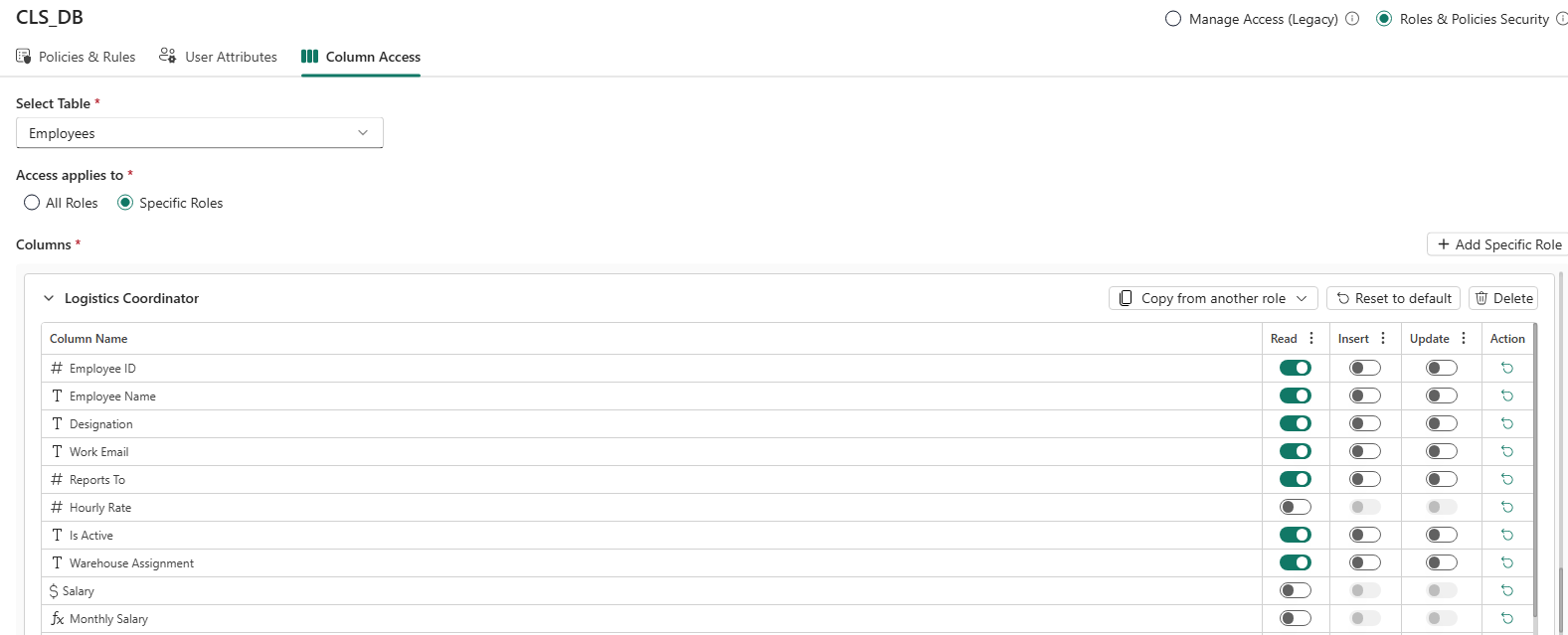
Problem: The HR team needs Salary, Hourly Rate, and Monthly Salary, but Warehouse Managers and Logistics Coordinators should not see them.
What changes: You can turn off Read for specific columns and roles. The column is hidden from the grid and from other product areas where columns can be selected, and Insert and Update are disabled for it.
| User role | Column access |
|---|---|
| HR Team | Can view all columns |
| Warehouse Manager | Salary, Hourly Rate, and Monthly Salary are hidden |
| Logistics Coordinator | Salary, Hourly Rate, and Monthly Salary are hidden |
What each role sees
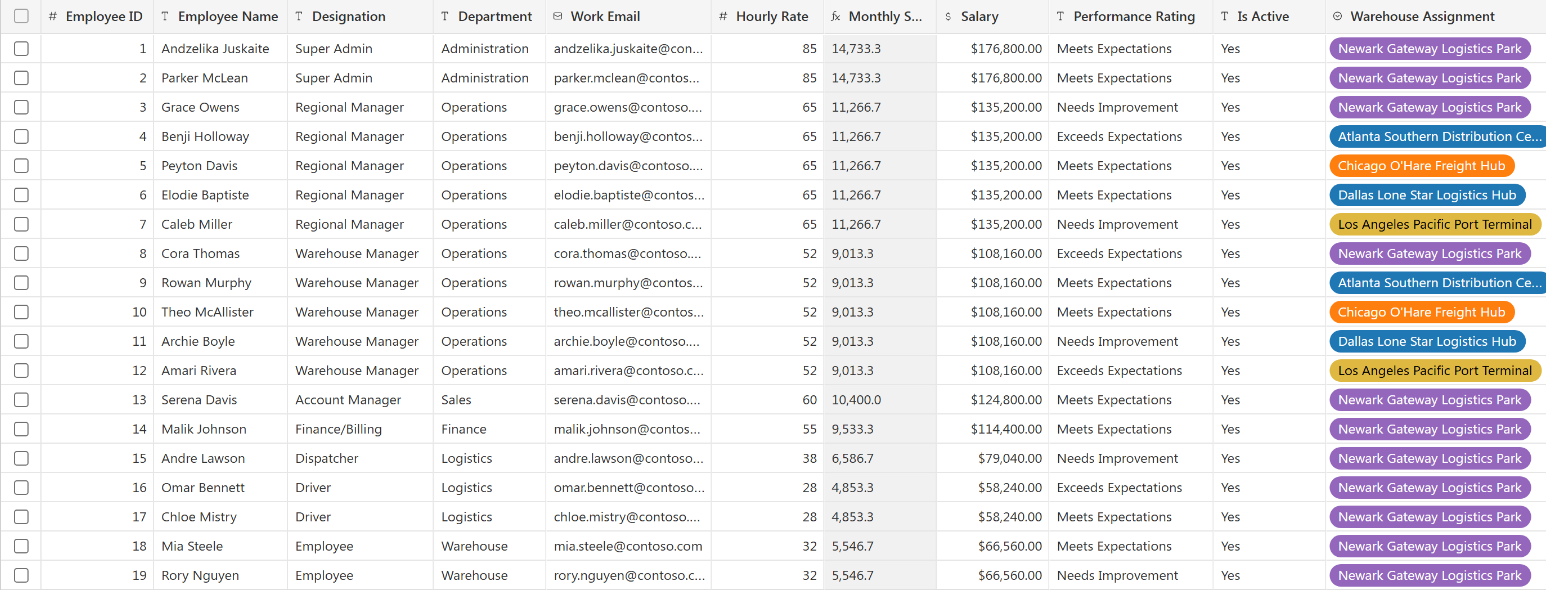
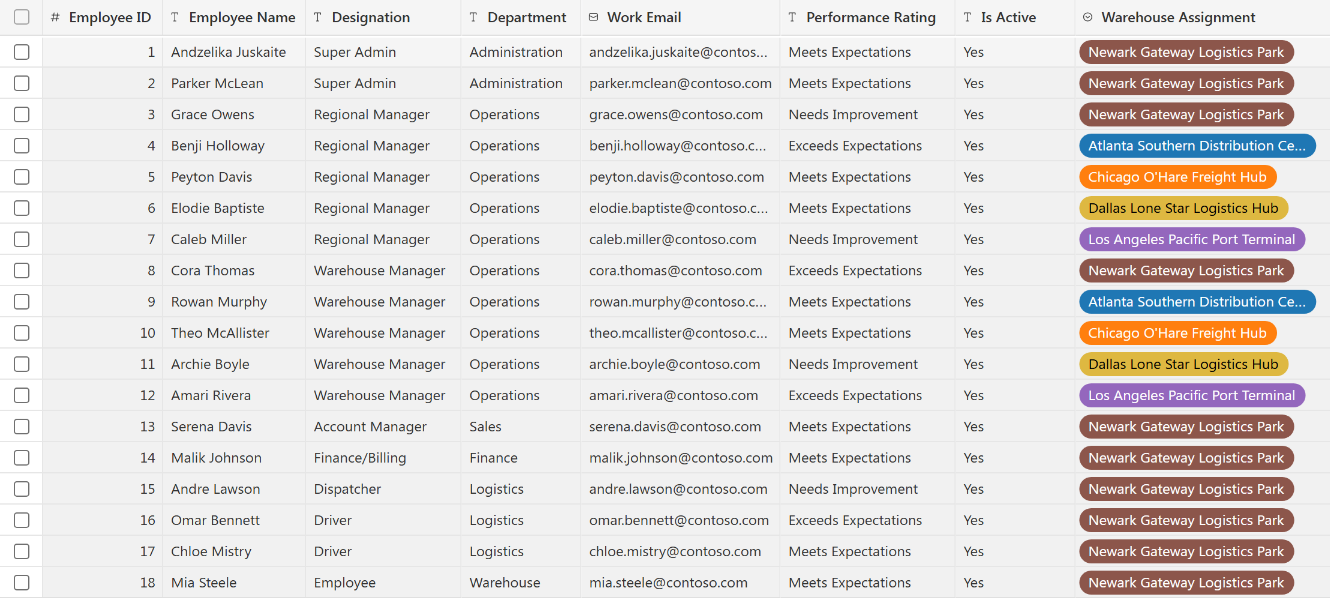
How to configure
Turn off Update for a column, and users can still see its values but can no longer change them.
Problem: Warehouse Managers need to keep the Is Active status of their team current, but should not change other employee details such as Department or Designation. Logistics Coordinators only need to view employee details. HR must keep the ability to update them all.
What changes: Update is controlled independently for each column. With Read on and Update off, the column is view only.
| User role | Department | Designation | Is Active |
|---|---|---|---|
| HR Team | View and Update | View and Update | View and Update |
| Warehouse Manager | View only | View only | View and Update |
| Logistics Coordinator | View only | View only | View only |
What it looks like

How to configure
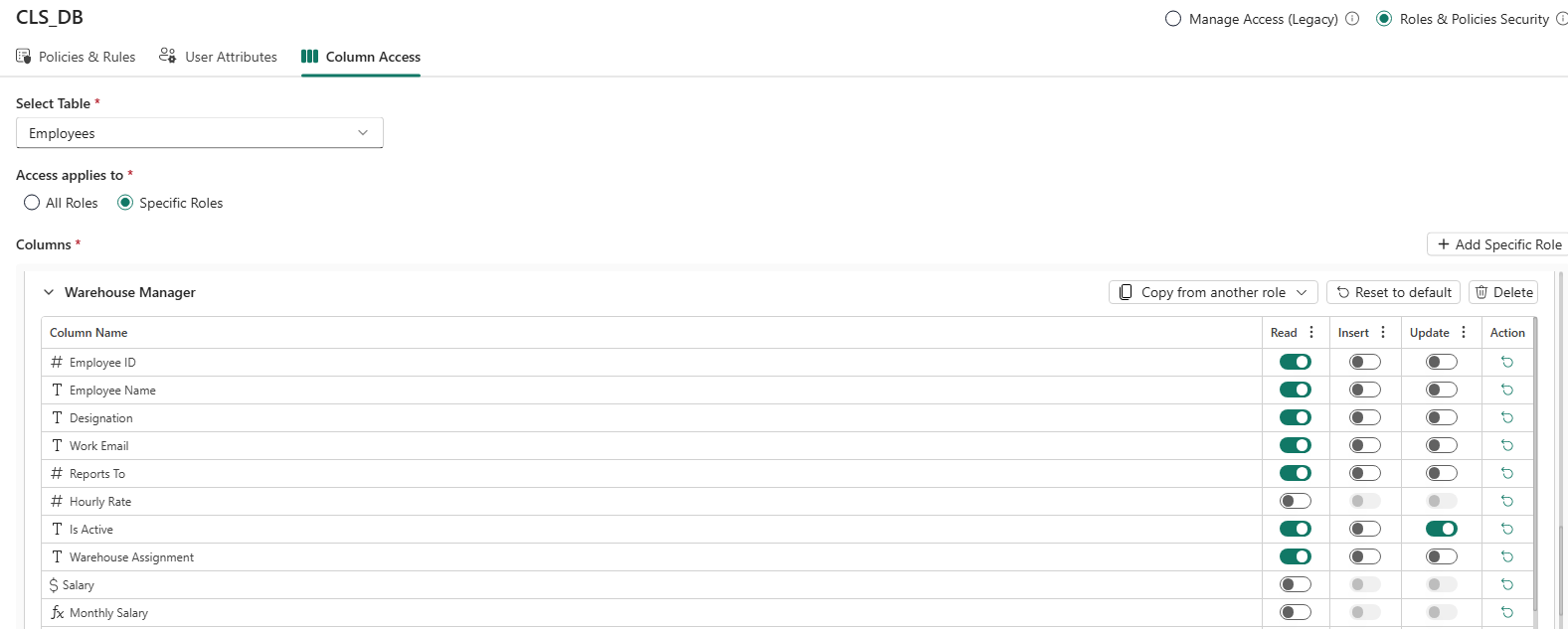
Pair Column Access with row-level security to control both which records and which columns each user can reach.
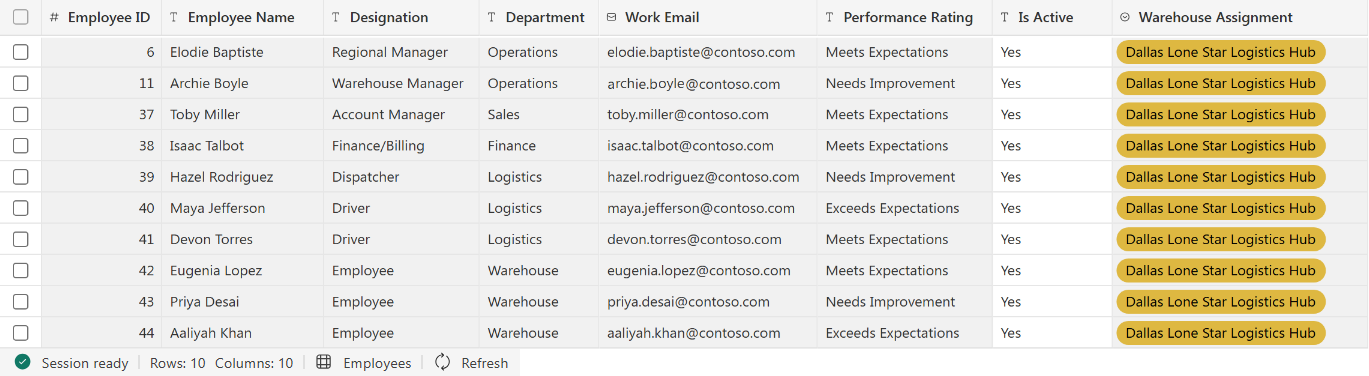
Problem: Each Warehouse Manager should see employees only from their own warehouse. The Dallas Warehouse Manager, for example, should not see records from Newark, Atlanta, Chicago, or Los Angeles. Column Access controls columns, not rows.
What changes: Row-Level Security (RLS) decides which records a user can access, and Column Access decides which columns. A policy limits the Dallas Warehouse Manager to records where Warehouse Assignment is Dallas Lone Star Logistics Hub, and Column Access hides Salary, Hourly Rate, and Monthly Salary for the Warehouse Manager role.
| Access requirement | Result |
|---|---|
| Warehouse-level access | Only the 10 Dallas employee records |
| Column-level access | Salary, Hourly Rate, and Monthly Salary are hidden |
What it looks like
How to configure
Column Access completes PowerTable’s security model. Together with row-level security, it controls both which records and which columns each role can view, insert, and update.
One shared table. The right access for every role, down to the column.
Ready to secure your shared tables?
Feature details reflect Fabric Plan at the time of writing.
Audit Cell History in Fabric Plan shows who changed a planning cell, what changed, and when, and lets you undo any user’s change by restoring an earlier value. It is available now with the Native Planning Engine, in Public Preview.
Return any selected cell to a value recorded by any user at any point in its available history.
Choose an entry from the cell’s timeline and restore that exact value. The restoration is captured as a new auditable change, so recovery does not break the history.
Important compatibility note: Cell History is available only with the Native Planning Engine. It relies on the engine’s file-based architecture in OneLake and is not supported by the previous planning engine.
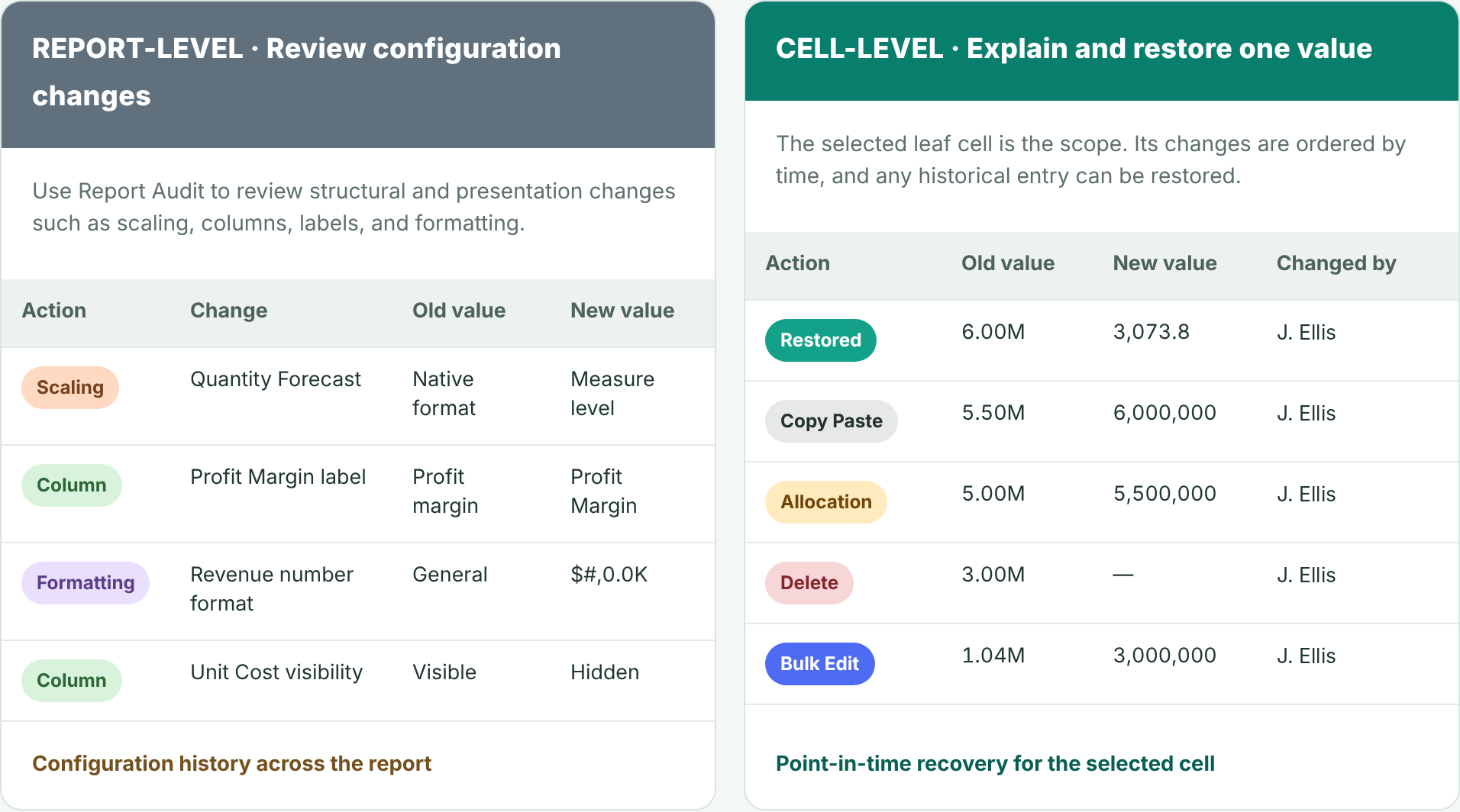
Fabric Plan already provides a detailed audit experience. The Data Input tab captures sheet-wide data activity: tag, action, row, column, old value, new value, user, and timestamp. The Reports tab captures report changes such as scaling, columns, and formatting.
Cell History complements those broad views with a focused, actionable timeline for the value a planner has selected. The row, measure, period, user, action, and value transitions are presented together, directly beside the planning grid. A planner can then select any recorded entry and restore that exact value to the cell.
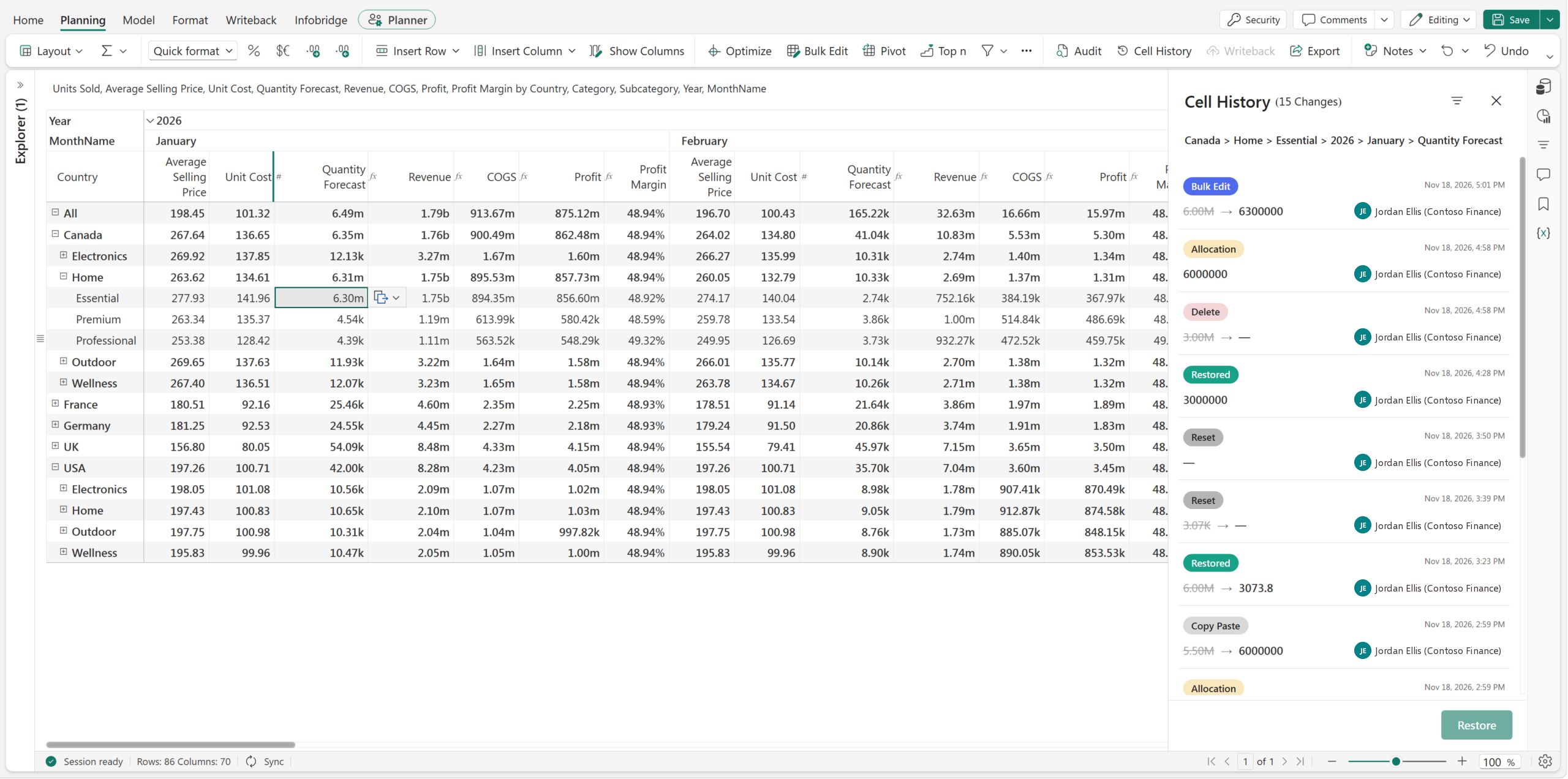
Select the January Quantity Forecast for Canada › Home › Essential (6.30M) and open its complete change story in context.
Report Audit explains how the report changed. Cell History explains, and can restore, one planning value.
Cell History is available for a leaf-level data-input cell. Select a specific intersection of business context and time, such as Canada, Home, Essential, January 2026, Quantity Forecast, and open Cell History. The side panel keeps that complete coordinate visible while it lists the recorded changes from newest to oldest.
Canada › Home › Essential › 2026 › January › Quantity Forecast
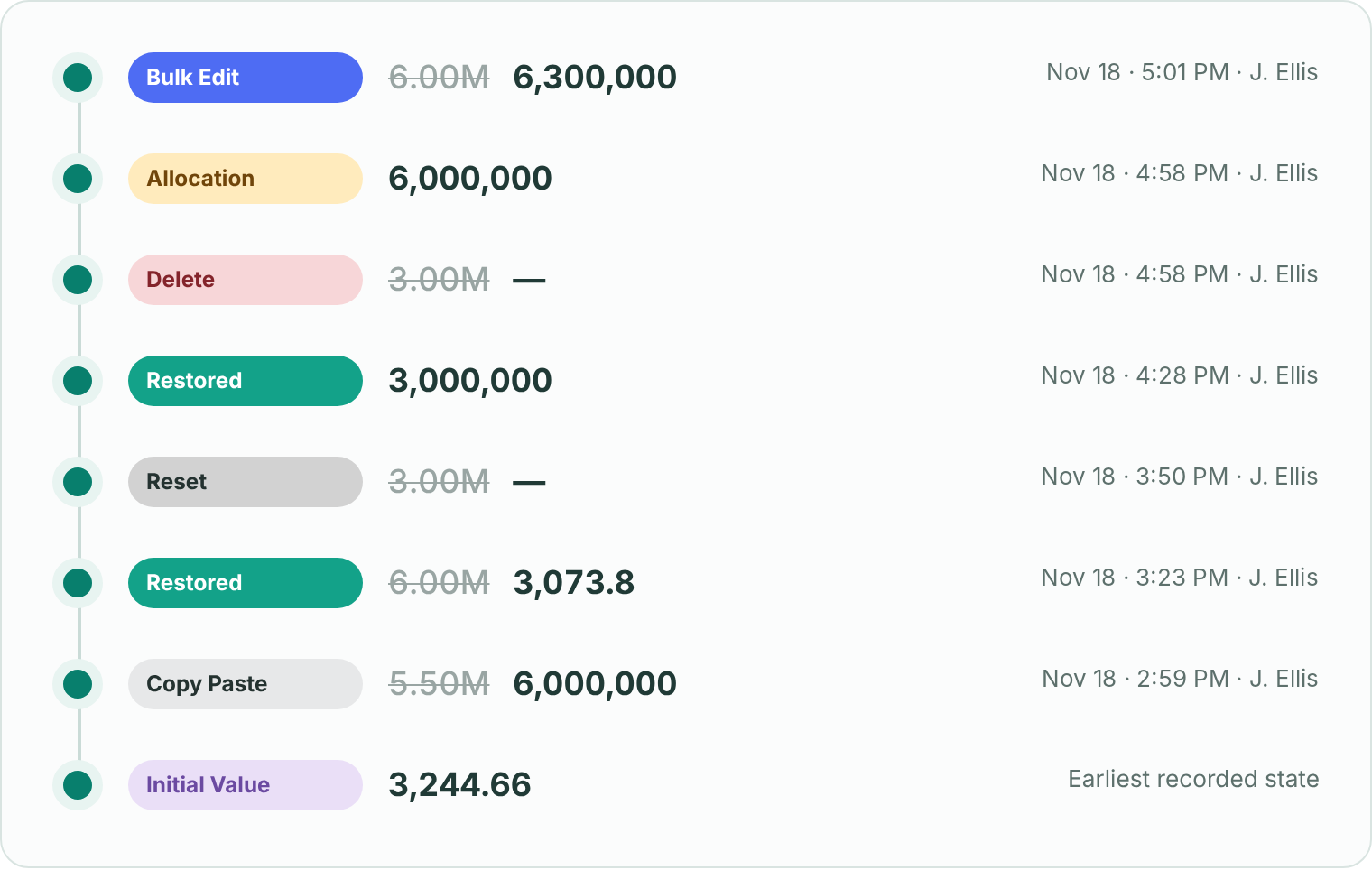
Each entry identifies the mechanism that produced the change. A leaf value may have changed through direct input, an allocation from a parent, a bulk update, or pasted values. Cell History keeps those actions distinct.
| Change type | What it means |
|---|---|
| Initial Value | The earliest recorded state of the cell, before any tracked change. |
| Allocation | A value entered at a parent or subtotal was distributed down to this leaf cell. |
| Manual Input | A planner directly edited this leaf-level value in the grid. |
| Bulk Edit | The cell changed as part of a multi-cell update configured through Bulk Edit. |
| Copy Paste | The value was pasted from another grid range or from outside the planning experience. |
| Delete | The planned value was removed, leaving the leaf cell blank until another action supplied a value. |
| Restored | A user intentionally returned the cell to one of its recorded historical values. |
| Reset | The cell returned to its configured default, or to blank when no default exists. |
A cell can accumulate many changes. The filter panel narrows the list while the selected cell remains fixed.
Show only allocations made by a specific user, isolate deleted values or manual inputs, or limit the list to a selected date range.
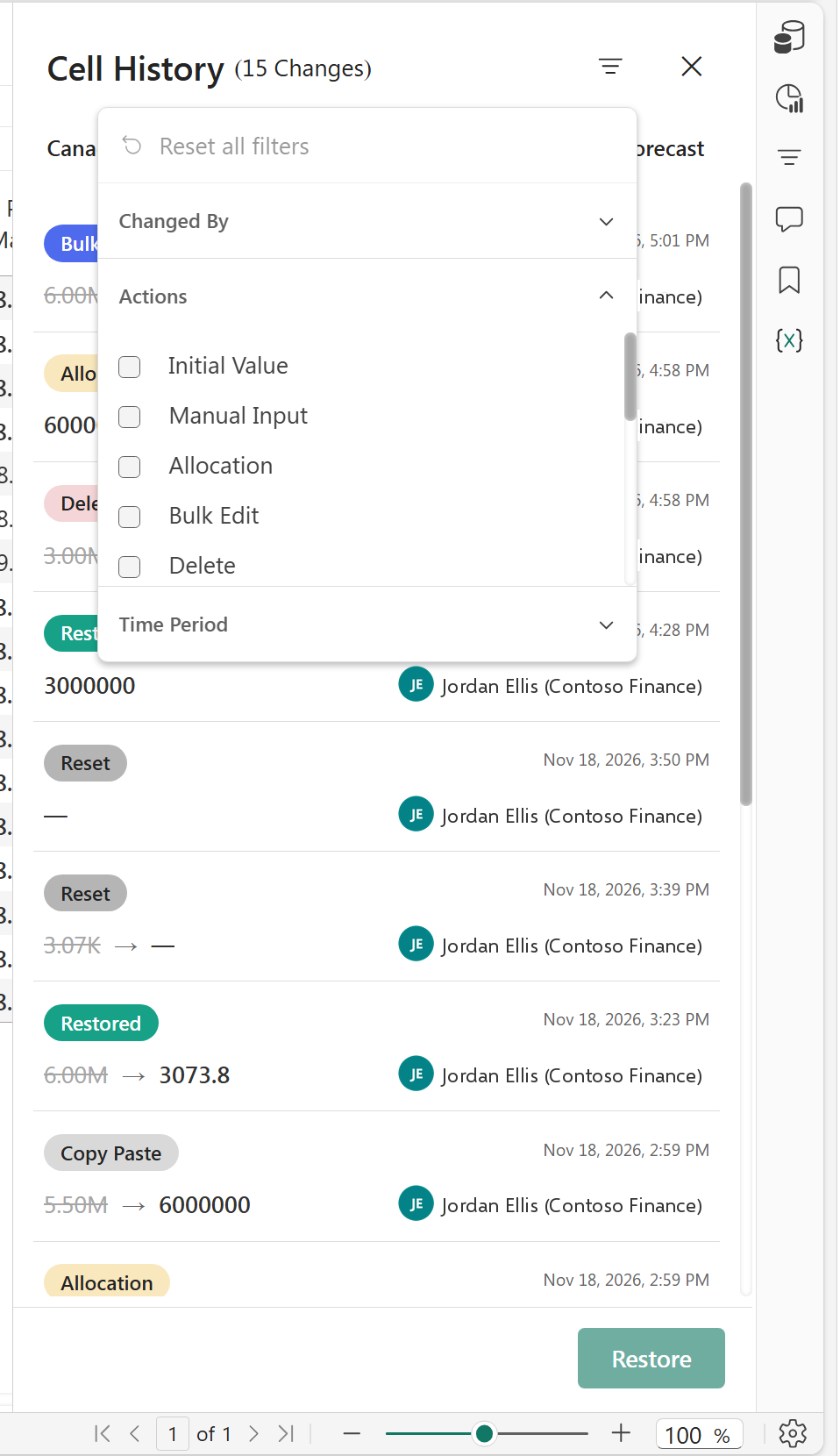
Use Changed By, Actions, or Time Period to locate the exact entry. Select it and choose Restore to return the leaf cell to that recorded value, regardless of which user originally made the change. The restoration is recorded as another change in the cell history.
| Action | What it does |
|---|---|
| Restore | Return the selected cell to a specific value from any point in its available history. |
| Delete | Remove the current planned value. Cell History records the old value changing to blank as a Delete action. |
| Reset | Remove the current planned input and return the cell to its configured default. If the default is blank, the cell returns to blank. |
The two experiences are complementary. Audit is designed for broad review and export, while Cell History is designed for focused investigation and recovery at the selected leaf-level cell.
| Capability | Audit | Cell History |
|---|---|---|
| Scope | Entire report history across data-input and report-configuration activity | One selected leaf-level cell |
| Change context | Report-wide records for review and governance | Who changed it, What changed, and When |
| Undo and Restore | Not supported | Undo a specific change by restoring its selected historical value |
| Export | Export the entire report history to Excel | Cell-level history export is not supported |
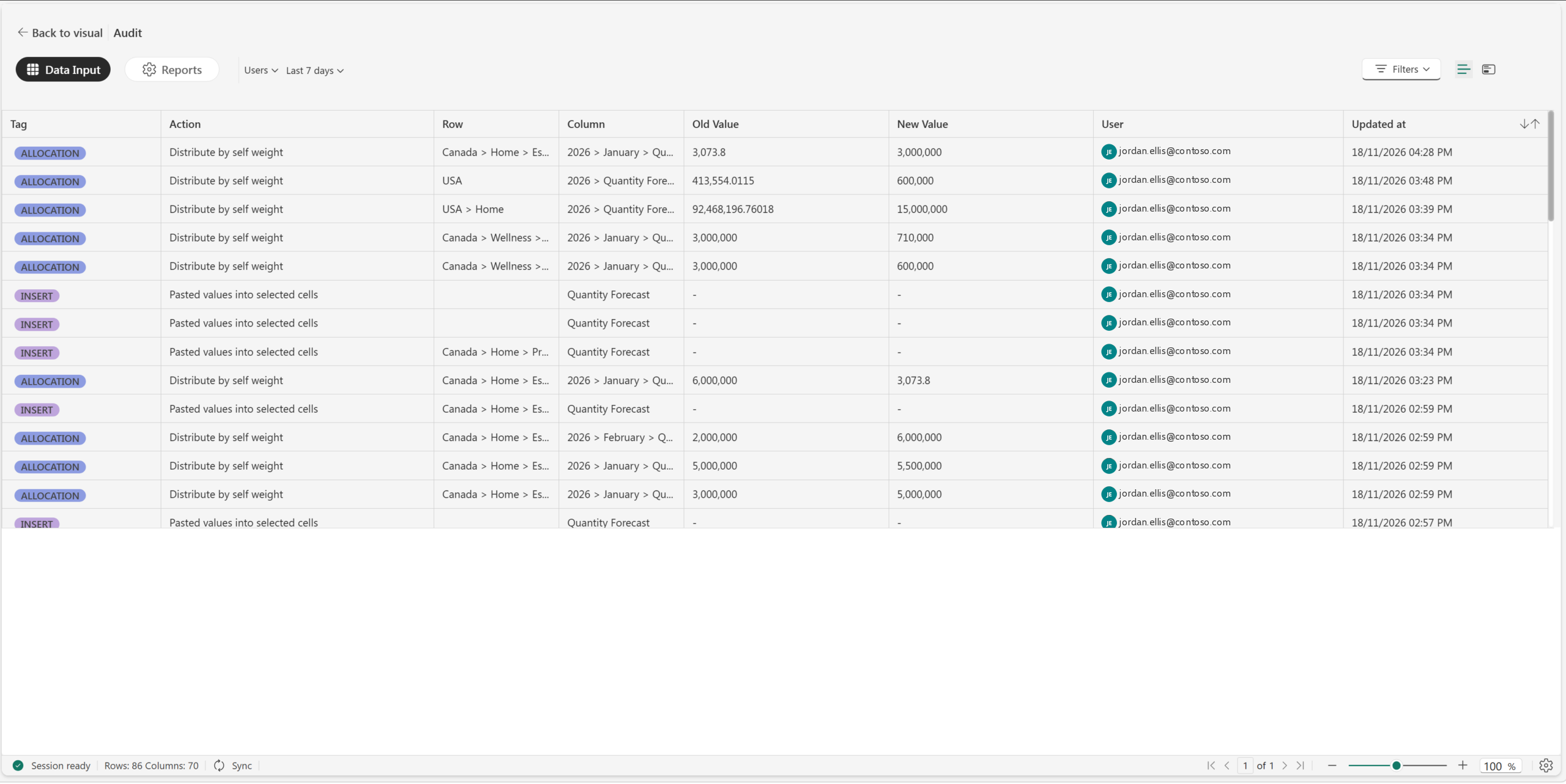
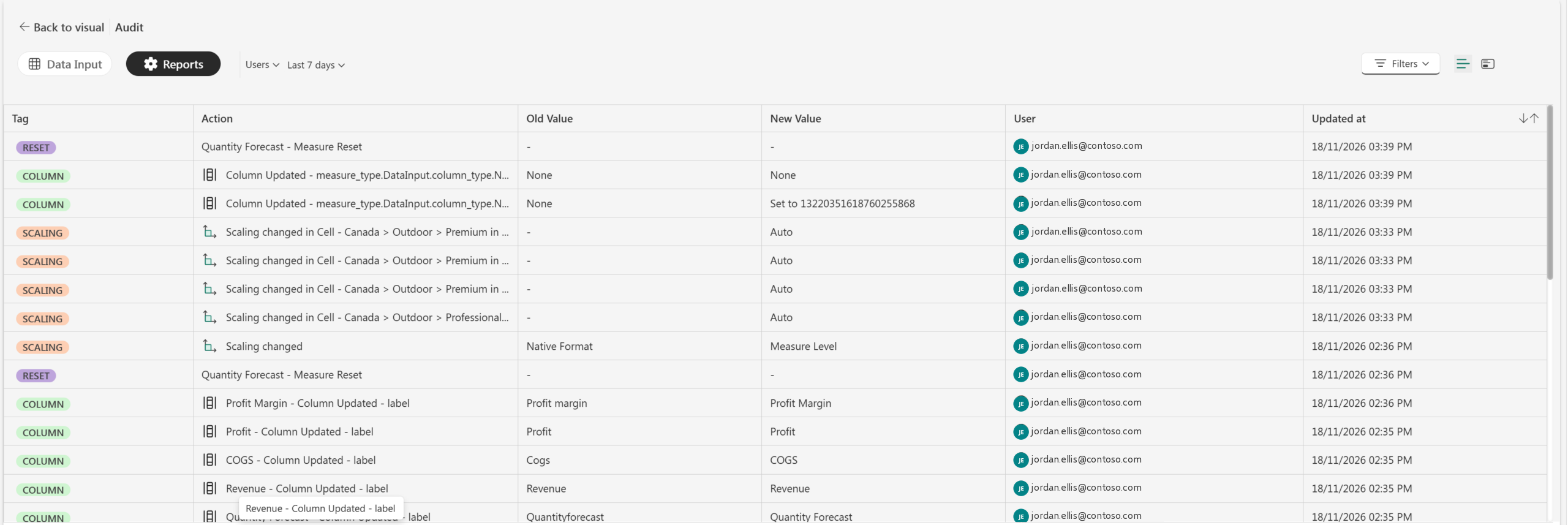
Cell History turns audit information into a recovery workflow. A planner can see whether a value came from a direct edit, allocation, bulk update, paste, or deletion; identify the user and time; and restore the exact recorded value from any selected point in the cell’s available history.
The feature is intentionally narrow: it applies to a selected leaf-level input cell. Sheet-wide data changes remain in Data Input audit, and report configuration changes remain in Reports audit.
Feature details reflect Fabric Plan at the time of writing.