If you plan for a group of companies, you know how this goes. Every entity sends its own P&L, balance sheet and cash flow. The holding company has lines the trading company doesn’t have. In many groups, someone in finance stitches it all together in a separate consolidation file. When a new entity comes in, that file needs rework.
Take Meridian Atlas Group for example – it has two organizations, Atlas and Meridian, each with regions, branches and departments under them, and every department plans its own statements. The CFO wants one consolidated P&L for the group, and the same numbers by organization or region whenever she asks.
In Fabric Plan you do this with one statement template that every entity uses. Rolling the entities up into the group view is then a pivot on the same data. This post covers that roll-up; intercompany eliminations and adjustments are a topic of their own. Here’s how it’s set up.
The template holds the income statement, balance sheet and cash flow. Each statement is its own block, so an entity gets all three or only the ones it needs. Entities don’t need identical structures either. A trading company adds a gross margin block. A services company carries operating expenses only. A holding company adds holding income. The chart of lines stays the same, so the entities stay comparable.

Each line carries two roll-up rules: one for adding across entities and one for adding across time.

Revenue for a quarter is the sum of its months. Cash at the end of the quarter is the closing balance. A margin is weighted by its denominator, so it’s right at every level. Subtotals like EBITDA are rebuilt from their parts.
Easy way to see it: expand a year into quarters. The income statement quarter adds up its three months. The balance sheet quarter shows the closing balance. Both come from the same template.
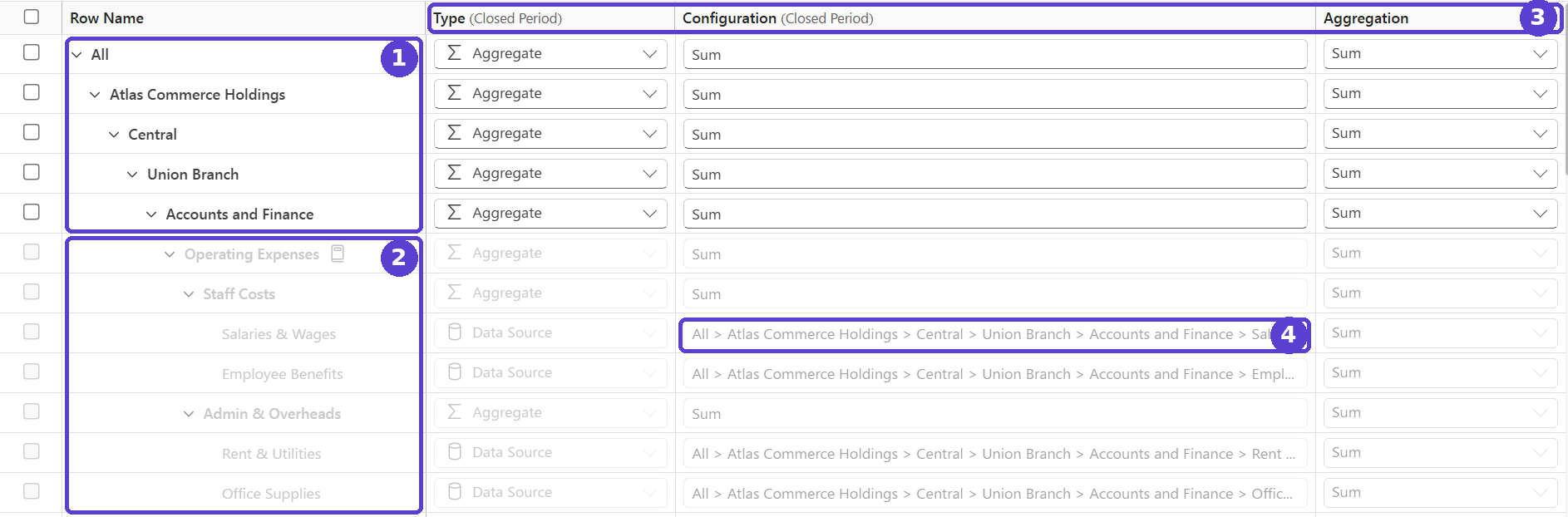
Every row in this example is a simple Sum. Formulas and more complex logic in the Configuration roll up properly too.
The group view reads the same data. Pivot the entity hierarchy to see the group, a region or a single legal entity. Every total reconciles to the entities beneath it.
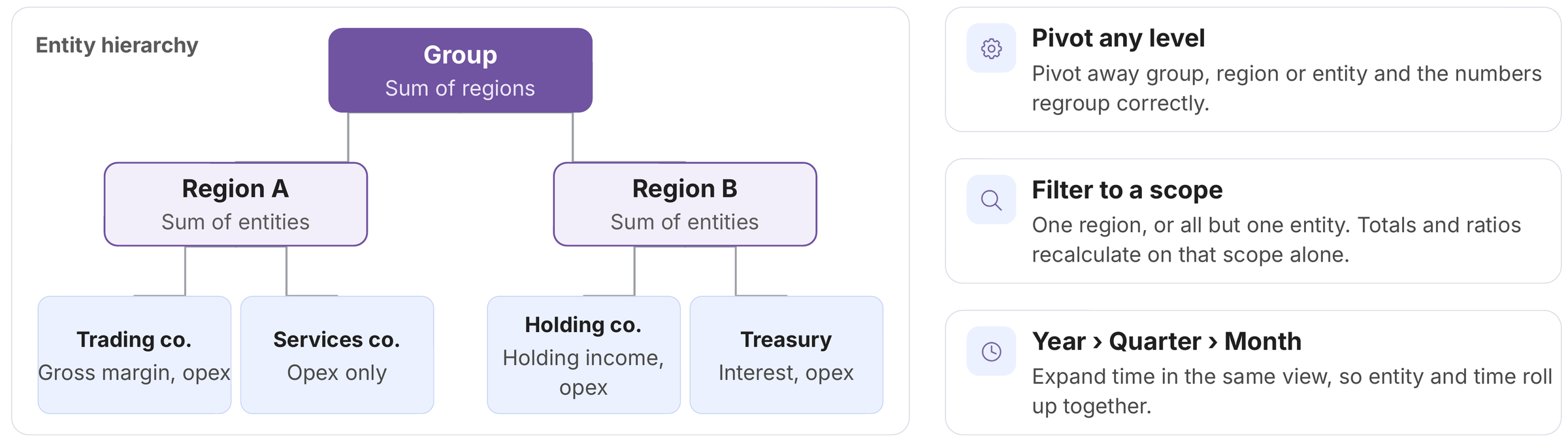
Filter to one region, or to every entity but one, and totals and ratios recalculate on that scope alone. A line shows in a total only if an entity in scope has it, and it adds up only the entities that do. Expand Year, Quarter and Month in the same view and entity and time roll up together.
Profit centers and cost centers net correctly: trading entities add to the total and cost-only entities take away from it. The group margin is the true blended margin, worked out from group totals.
Here’s the group P&L the CFO asked for, with every organization’s statement beneath it.
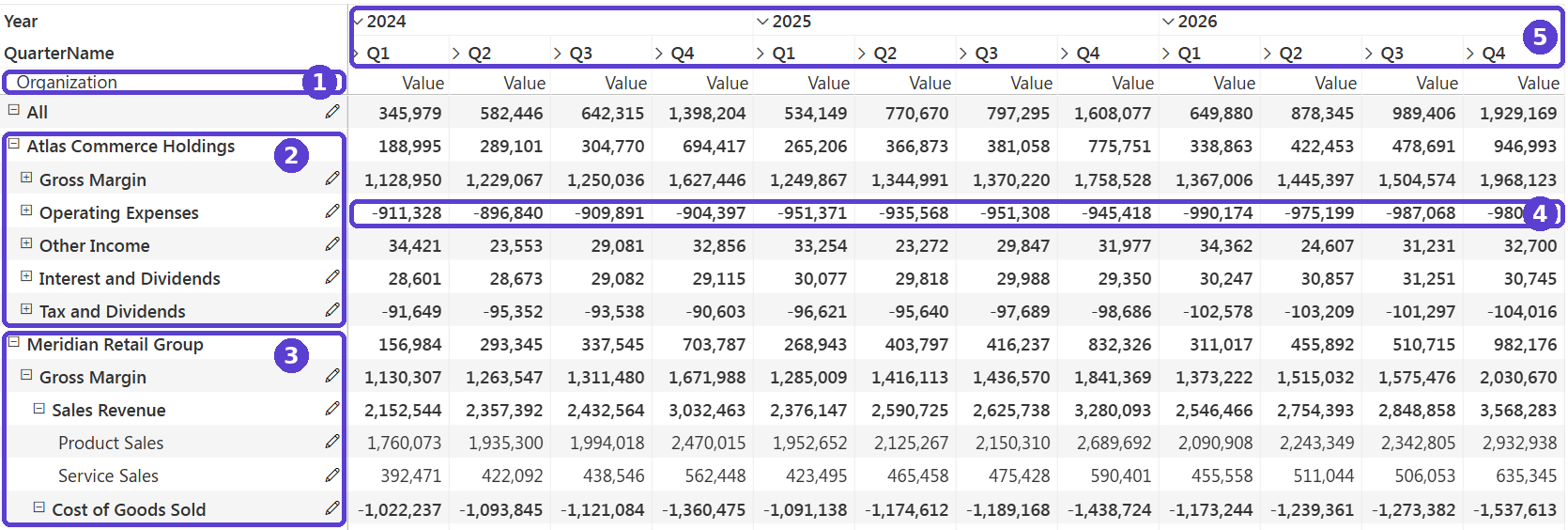

Once the roll-up rules are in place, new entities need no extra setup. A new region, department or entity that shows up in the row dimensions with values is consolidated automatically. It just has to sit under the anchor row. Add a new region to the source data with its values and refresh. It flows into every total above it on its own.
Please log in to comment.
"intercompany eliminations and adjustments are a topic of their own" - I'm looking forward to that topic. Some EPM/CPM tools simply used SQL stored procedures. It is valuable to have the a marketing link for Fabric Plan directly addressing this functionality requirement for FP&A teams. e.g. https://www.anaplan.com/solutions/financial-consolidation/
https://www.solverglobal.com/product/template-marketplace/intercompany-elimination-input-2-planning

Dear Lumel team, we are convinced the platforms offers everything for an end2end Corporate Performance Management. Have you also thought about the best way to perform IFRS adjustments, deferred taxes and all other special cases (esp. in equity consolidation / goodwill etc.)?
You must be logged in to post a comment.




Dear Lumel team, we are convinced the platforms offers everything for an end2end Corporate Performance Management. Have you also thought about the best way to perform IFRS adjustments, deferred taxes and all other special cases (esp. in equity consolidation / goodwill etc.)?
"intercompany eliminations and adjustments are a topic of their own" - I'm looking forward to that topic. Some EPM/CPM tools simply used SQL stored procedures. It is valuable to have the a marketing link for Fabric Plan directly addressing this functionality requirement for FP&A teams. e.g. https://www.anaplan.com/solutions/financial-consolidation/
https://www.solverglobal.com/product/template-marketplace/intercompany-elimination-input-2-planning